Single-Cell Resolution for Transcriptional and Regulatory Discovery

Epigenome Technologies runs validated single-cell RNA-seq, ATAC-seq, and multiome workflows generating high-quality cell-type-specific expression profiles, chromatin accessibility maps, and integrated regulatory landscapes. We qualify inputs, run the benchwork, and deliver interpretable outputs that drive the next phase of your research.

scRNA-seq

Cell-Type Resolution

Transcriptome-wide profiling for rare population discovery and trajectory inference.

scATAC-seq

Regulatory Elements

Single-cell chromatin accessibility for TF motif enrichment and state heterogeneity.

Multiome + Spatial

Integrated Landscapes

Paired chromatin-expression and spatial profiling with tissue architecture preservation.

Choose the right single-cell profiling method

Service Cat. No Input Requirements Best For Inquiry
scRNA-seq (3' or 5') SCRNA-301 500 to 10K cells/sample Cell-type identification, differential expression Quote
scATAC-seq SCATC-302 1K to 10K nuclei/sample Regulatory element discovery, open chromatin Quote
Multiome (ATAC+RNA) MULTI-303 1K to 10K nuclei/sample Integrated regulatory landscapes Quote
Spatial RNA (Takara Trekker) SPRNA-304 Fresh-frozen tissue sections Tissue architecture, cell-cell interactions Quote
Spatial Multiome (Takara Trekker) SPMLT-305 Fresh-frozen tissue sections Spatial regulatory landscapes Quote

Why single-cell resolution?

Single-cell profiling reveals insights bulk measurements obscure—cellular heterogeneity within tissues and disease states, rare population identification (immune infiltrates, stem cell niches, drug-resistant clones), developmental trajectories and lineage commitment decisions, and regulatory mechanisms linking chromatin state to transcriptional output at single-cell resolution.

Dotplot heatmap of single-cell RNA markers - human cortex
Single-cell data reveals cellular changes in specific cell types that are hard to identify in bulk.

Common applications

  • Tumor microenvironment profiling with spatial architecture of tumor-immune interfaces
  • Developmental biology: lineage trajectory inference and spatial organization of developmental niches
  • Rare population discovery: stem cell niches, drug-resistant clones, transitional cell states
  • Regulatory mechanism mapping: enhancer-gene linkage and TF activity inference
  • Biomarker discovery: cell-type-specific markers for diagnostics and patient stratification
  • Tissue architecture and cell-cell interactions using Takara Trekker spatial profiling

Included with every engagement

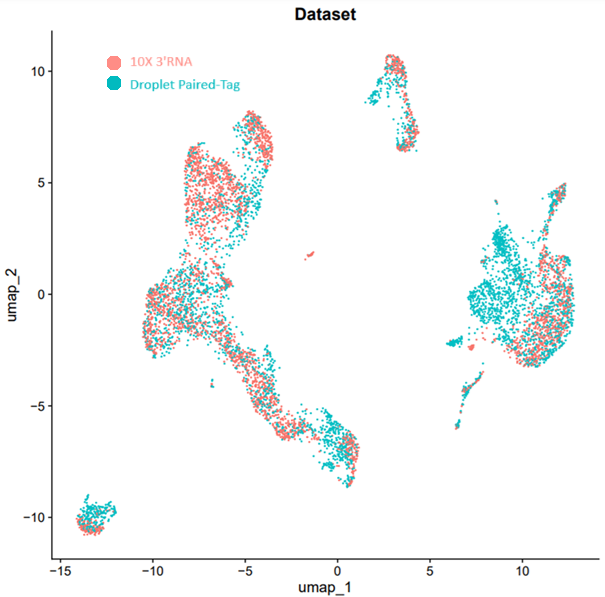
Integration workflow showing data harmonization across single-cell modalities
Integrated analysis across modalities reveals comprehensive regulatory landscapes.
  • Joint design sessions align sample availability, platform selection (10x Genomics, BD Rhapsody, Takara Trekker), and QC thresholds
  • Project scientists embedded through cell calling, clustering, and interpretation
  • Standard clustering and differential expression/accessibility analysis included
  • Custom trajectory inference, RNA velocity, spatial neighborhood analysis available on request
  • Integration briefs consolidate single-cell data with bulk or third-party datasets

scRNA-seq: Cell-Type Identification and Transcriptional State Mapping

Single-cell RNA sequencing quantifies transcript abundance at single-cell resolution, revealing cellular heterogeneity, rare populations, and developmental trajectories that bulk measurements obscure. We deploy 10x Genomics Chromium (3' and 5' chemistry) and BD Rhapsody platforms for transcriptome-wide or targeted profiling, with FFPE-compatible workflows for archival specimens.

UMAP of human PBMC snRNA-seq data
High-quality single-cell and single-nucleus RNA-seq in PBMC.

Best for

  • Cell-type identification and annotation in complex tissues
  • Rare population discovery (immune subsets, cancer stem cells, resistant clones)
  • Differential expression analysis across conditions or time points
  • Trajectory inference and lineage commitment mapping
  • Fresh cells, cryopreserved PBMC, dissociated tissues, or FFPE specimens

Compatible samples

  • Cell lines
  • Cryopreserved tissues or cells
  • Flash-frozen tissues (nuclei)
UMAP embedding showing single-cell RNA-seq clustering
scRNA-seq delivers cell-type-specific transcriptional profiling with rare population identification.

QC metrics

  • Cell recovery: 500–10,000 cells per sample
  • Reads per cell: 20,000–50,000 (3' GEX), 50,000–100,000 (5' GEX)
  • Genes detected: >1,000 per cell (median)
  • Mitochondrial percentage: <10% (quality threshold)
  • Replicate correlation > 0.90
Scatterplot of quality control transcripts
Sample optimization results in clean recovery of cellular transcriptomes.

Workflow

  1. Plan

    Sample qualification with viability assessment, platform selection (10x or BD Rhapsody), and sequencing depth determination.

  2. Partition & barcode

    Cell encapsulation, barcoding, and reverse transcription with integrated debris filtering and doublet detection.

  3. Library construction

    cDNA amplification and library prep (3' or 5' chemistry) with QC on yield, fragment size, and complexity.

  4. Sequence & analyze

    NovaSeq or NextSeq sequencing, followed by cell calling, clustering, differential expression, and trajectory inference.

Deliverables

  • FASTQ files and cell-barcode matrices
  • UMAP/t-SNE embeddings with cell-type annotations
  • Differential expression tables with marker gene lists
  • QC reports: cell recovery, reads per cell, genes detected, mitochondrial percentage
  • Optional trajectory inference, RNA velocity, integration with external datasets

Advantages

  • Transcriptome-wide profiling without prior gene selection
  • Rare population discovery at single-cell resolution
  • Compatible with fresh, cryopreserved, and FFPE samples
  • Flexible platforms: 10x Chromium, Illumina PIPSeq
  • Trajectory inference reveals developmental and disease progression dynamics

scATAC-seq: Single-Cell Chromatin Accessibility Profiling

Single-cell ATAC-seq maps chromatin accessibility at single-cell resolution, revealing regulatory element activity, TF binding motifs, and chromatin state heterogeneity across cell types. We use 10x Genomics Chromium ATAC workflows to profile genome-wide accessibility, identifying cell-type-specific enhancers and silencers that drive transcriptional programs.

Best for

  • Regulatory element discovery at single-cell resolution
  • TF motif enrichment and binding site prediction
  • Chromatin state heterogeneity across cell types
  • Gene activity scoring without RNA measurement
  • Nuclei from frozen samples, fresh tissues, or dissociated cells

TSS enrichment heatmap for ATAC-seq
High-quality chromatin accessibility data across replicates

QC metrics

  • Nuclei recovery: 1,000–10,000 per sample
  • Reads per nuclei: 10,000–25,000 (median)
  • TSS enrichment: >7
  • Fraction of reads in peaks (FRiP): >0.20
  • Pseudobulk peak concordance with bulk ATAC-seq
scATAC-seq UMAP plot showing two distinct populations based on condition
scATAC-seq reveals cell-type-specific chromatin accessibility and regulatory element activity.

IGV tracks showing chromatin accessibility between two conditions
Localize cell-specific differences in regulatory element accessibility between conditions.

Workflow

  1. Plan

    Nuclei isolation protocol optimization, sample qualification with debris assessment, and sequencing depth planning.

  2. Partition & transpose

    Nuclei encapsulation, barcoding, and tagmentation with integrated QC on nuclei quality and transposition efficiency.

  3. Library construction

    Amplification and library prep with QC on fragment size distribution (nucleosomal ladder) and complexity.

  4. Sequence & analyze

    NovaSeq sequencing, followed by cell calling, peak calling, motif enrichment, gene activity scoring, and clustering.

Deliverables

  • FASTQ files and peak-by-cell matrices
  • Cell-type-specific peak sets with accessibility scores
  • TF motif enrichment analysis per cluster
  • Gene activity scores linking accessibility to expression
  • QC reports: TSS enrichment, FRiP, fragment size distributions, pseudobulk concordance

Advantages

  • Genome-wide accessibility profiling without prior target selection
  • Cell-type-specific regulatory element identification
  • TF activity inference through motif enrichment
  • Compatible with frozen samples and nuclei isolation
  • Gene activity scores provide transcriptional predictions without RNA-seq

Multiome (ATAC+RNA): Integrated Chromatin and Expression Landscapes

Pairwise correlation showing RNA-ATAC concordance across genes and regulatory elements, along with UMAP embeddings
Multiome pairwise analysis links chromatin accessibility to gene expression.

Best for

  • Integrated regulatory landscapes linking chromatin to expression
  • Enhancer-gene correlation and linkage analysis
  • Joint clustering revealing chromatin-expression concordance
  • TF activity inference validated by target gene expression
  • Mechanistic studies requiring both layers from the same cell

IGV of cluster-level ATAC pseudobulk
Single-cell multiome identifies changes in chromatin expression that drive expression differences between cell states.

QC metrics

  • Nuclei recovery: 1,000–10,000 per sample
  • ATAC reads per nuclei: 10,000–25,000
  • RNA reads per nuclei: 20,000–50,000
  • ATAC TSS enrichment >7, FRiP >0.20
  • RNA genes detected >1,000, mitochondrial % <10%
QC metrics dashboard showing ATAC and RNA quality across multiome samples
Comprehensive QC metrics ensure high-quality multiome data across both modalities.

Workflow

  1. Plan

    Nuclei isolation optimization, sample qualification, and dual-modality sequencing depth planning (ATAC + RNA).

  2. Partition & profile

    Nuclei encapsulation with simultaneous ATAC tagmentation and RNA capture from the same cell, with integrated barcoding.

  3. Library construction

    Separate ATAC and RNA library prep from barcoded material with QC on both modalities (fragment size, yield, complexity).

  4. Sequence & integrate

    Dual sequencing (ATAC + RNA), followed by joint cell calling, clustering, enhancer-gene linkage, and integrated analysis.

Deliverables

  • FASTQ files and dual matrices (ATAC peak-by-cell, RNA gene-by-cell)
  • Joint UMAP embeddings demonstrating chromatin-expression concordance
  • Enhancer-gene correlation matrices and linkage predictions
  • TF activity scores validated by target gene expression
  • Integrated QC reports covering both ATAC and RNA modalities

Advantages

  • Paired chromatin and expression from the same cell eliminates ambiguity
  • Direct enhancer-gene linkage without computational inference
  • TF activity validated by downstream target expression
  • Joint clustering reveals regulatory mechanisms driving cell states
  • Single workflow captures both regulatory layers efficiently

Spatial RNA/Multiome: Tissue Architecture and Cell-Cell Interactions

Takara Trekker spatial profiling captures spatially-resolved RNA or multiome (ATAC+RNA) data from fresh-frozen tissue sections, preserving native tissue architecture and enabling cell-cell interaction analysis, neighborhood enrichment, and spatial gene expression gradients. We deploy Trekker workflows for tumor microenvironment mapping, developmental niche characterization, and spatial regulatory landscape profiling.

Best for

  • Tumor microenvironment mapping with spatial immune infiltrate characterization
  • Developmental niche organization and spatial lineage transitions
  • Cell-cell interaction networks and ligand-receptor signaling
  • Spatial gene expression gradients and neighborhood effects
  • Tissue-level chromatin dynamics with spatial multiome profiling

Pixel-free Spatial Resolution

Curio Trekker spatial coordinates, colored by Leiden cluster
True single-cell/single-nucleus profiling with spatial coordinates.

QC metrics

  • Cell/Nuclear Capture: 10K/lane, up to 60% of all cells
  • Cells individually labeled, no spots or pixels
  • Tissue morphology preservation and alignment to H&E imaging
  • Spatial correlation with known anatomical landmarks

Workflow

  1. Plan

    Tissue section preparation, cryosectioning optimization, and quality assessment with H&E staining.

  2. Capture & barcode

    Spatial capture on Takara Trekker slides with spatially-barcoded spots, followed by tissue permeabilization and RNA/ATAC capture.

  3. Library construction

    Spatial library prep (RNA or multiome) with QC on capture efficiency, spot-level yield, and tissue morphology preservation.

  4. Sequence & map

    NovaSeq sequencing, followed by spatial mapping, cell-type deconvolution, neighborhood enrichment, and cell-cell interaction analysis.

Deliverables

  • FASTQ files and spatial gene/peak expression matrices
  • Tissue section overlays with gene expression or accessibility heatmaps
  • Spatial cell-type mapping and deconvolution
  • Neighborhood enrichment analysis and cell-cell interaction networks
  • H&E imaging aligned to spatial transcriptome data

Advantages

  • Preserves native tissue architecture and spatial context
  • Cell-cell interaction analysis without dissociation artifacts
  • Spatial gene expression gradients reveal neighborhood effects
  • Tumor microenvironment mapping with immune infiltrate localization
  • Integrates with matched dissociated single-cell data

Partner with our scientists

Share your biological questions, sample availability, and study goals. We will return a scoped single-cell brief outlining recommended platform mix (scRNA-seq, scATAC-seq, multiome, or spatial), QC checkpoints, and downstream analysis.

  • Sample requirements: Platform-specific inputs from 500 cells (scRNA-seq) to fresh-frozen tissue sections (spatial) with low-input contingencies available.
  • Storage guidance: Fresh cells, cryopreserved PBMC, dissociated tissues, nuclei from frozen samples, or fresh-frozen tissue sections accepted with documented handling.
  • Data options: Raw FASTQ, processed matrices, clustering, differential analysis, and interpretive outputs available individually or bundled.
  • Support: Project scientists provide experimental planning and guidance, data reviews, and troubleshooting.