Quantitative Chromatin Profiling for Regulatory Discovery
Epigenome Technologies runs validated ChIP-seq, CUT&Run, and CUT&Tag assays so your project teams receive gold-standard protein-DNA interaction maps, histone modification landscapes, and transcription factor occupancy data. We align method selection to sample constraints and deliver ideal data for your experiment.
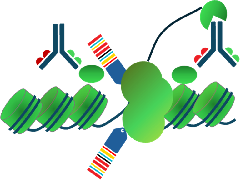
ChIP-seq
Gold Standard
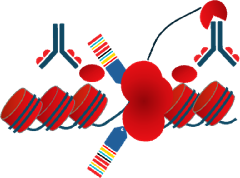
CUT&Run
Low Background
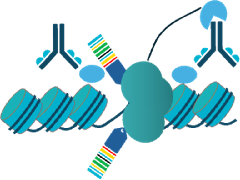
CUT&Tag
Ultra-Low-Input
Choose the right chromatin profiling method
| Service | Cat. No | Input Requirements | Background | Best For | Inquiry |
|---|---|---|---|---|---|
| ChIP-seq | EGT-CS-310 | ≥1M cells | Established | Gold standard, abundant targets, benchmarking | Request Quote |
| CUT&Run | EGT-CR-105 | 10K–100K cells | Reduced | Scarce samples, difficult targets, lower sequencing | Request Quote |
| CUT&Tag | EGT-CT-201 | 100–1,000 cells | Minimal | Ultra-low-input, single-cell, high-throughput | Request Quote |
Chromatin profiling for mechanistic discovery
ChIP-seq, CUT&Run, and CUT&Tag map protein-DNA interactions and histone modifications to define regulatory states. We emphasize when each modality delivers optimal signal-to-noise, resolution, and sample efficiency for specific biological questions.
Common applications
- Transcription factor binding site identification and regulatory network mapping
- Histone modification profiling for chromatin state annotation
- Enhancer and silencer element mapping for therapeutic targeting
- Drug response screens tracking chromatin remodeling
- Single-cell epigenetic heterogeneity in disease and development
- FFPE and archival specimen rescue for retrospective analysis
Included with every engagement
- Joint design sessions align sample availability, antibody validation, method selection, and controls
- Project scientists embedded through QC reviews, peak calling, and interpretation
- Peak calling and replicate concordance benchmarked to established standards
- Optional differential occupancy analysis and motif discovery for regulatory insights
ChIP-seq: Gold-Standard Chromatin Immunoprecipitation
For legacy comparisons or antibody panels best suited to immunoprecipitation, our ChIP-seq service offers full project management from chromatin preparation through sequencing and analysis. Established benchmark for mapping protein-DNA interactions through cross-linking, immunoprecipitation, and sequencing.
Best for
- High-input samples (≥1 million cells typical)
- Abundant transcription factors and histone marks
- Benchmarking and method validation studies
- Broad antibody compatibility requirements
- Cross-linked or native chromatin from diverse tissues and cell lines
QC metrics
- FRiP (Fraction of Reads in Peaks) ≥ 0.15
- NSC (Normalized Strand Coefficient) ≥ 1.05
- RSC (Relative Strand Correlation) ≥ 0.8
- Replicate correlation > 0.90
Workflow
-
Plan
Experiment design review, antibody sourcing guidance, and sample batching strategy.
-
Prepare chromatin
Cross-linking, chromatin shearing, and immunoprecipitation with QC on fragment distribution.
-
Library construction
Adapter ligation, size selection, and amplification with complexity assessment.
-
Sequence & analyze
Paired-end sequencing, peak calling, and integrated analysis connecting occupancy to gene regulation.
Deliverables
- Library QC metrics and sequencing-ready material or FASTQ delivery
- Peak calls, coverage tracks, and replicate concordance reports
- Detailed processing report with QC, coverage metrics, and call parameters
- Optional downstream integration with CUT&Tag or RNA outputs
Advantages
- Gold-standard methodology with extensive literature validation
- Broad antibody compatibility across targets
- Robust for abundant targets with established protocols
- Established QC benchmarks for quality assurance
CUT&Run: Low-Background, High-Resolution Mapping
CUT&Run delivers precise protein-DNA maps with minimal background by cleaving chromatin only at antibody-bound loci. In situ chromatin profiling using antibody-tethered enzyme cleavage eliminates cross-linking artifacts and reduces non-specific background. The assay is ideal for transcription factor discovery, enhancer validation, and studies limited by sample quantity.
Best for
- Low-input samples (50,000–100,000 cells)
- Targets with high non-specific background in ChIP-seq
- Studies requiring reduced sequencing costs
- Difficult-to-crosslink or labile protein targets
- Optimized workflows for transcription factors, cofactors, and chromatin remodelers
QC metrics
- FRiP ≥ 0.40 (typically higher than ChIP-seq)
- Background signal reduction vs ChIP-seq documented per target
- Spike-in normalization for quantitative comparisons
- Replicate correlation > 0.92
Workflow highlights
-
Plan
Sample batching, antibody validation, and controls with our scientists.
-
In situ binding
Cell permeabilization, antibody incubation, and protein A-MNase tethering.
-
On-bead digestion
Controlled chromatin cleavage at antibody-bound sites with integrated QC checks.
-
Library & analysis
Library prep, sequencing, and delivery of fastqs, basic analyses, and publication-ready figures.
Deliverables
- Library QC metrics with spike-in normalization curves
- FASTQ files and sequencing-ready material
- Peak calls with enrichment at known regulatory elements
- Comparative signal-to-noise analysis versus ChIP-seq
- Optional replicates for robust differential analysis
Advantages
- Reduced non-specific background compared to ChIP-seq
- Lower sequencing depth requirements (cost savings)
- Faster protocol without cross-linking steps
- Improved signal-to-noise for difficult targets
- Rapid turnaround for pilot validation
CUT&Tag: Ultra-Low-Input Antibody-Guided Tagmentation
CUT&Tag couples antibody targeting with tethered transposase to map histone marks or transcription factors with exceptional signal-to-noise. Direct tagmentation of antibody-bound chromatin using protein A-Tn5 fusion enables ultra-low-input profiling and single-cell compatibility. We routinely support projects with limiting input material, FFPE samples, and broad histone panels.
Best for
- Ultra-low-input samples (5,000–10,000 cells)
- Single-cell chromatin profiling
- Studies requiring minimal sample manipulation
- High-throughput screening with limited material
QC metrics
- FRiP ≥ 0.60
- Fragment size distribution with clear nucleosomal ladder
- Single-cell barcode quality and cell detection rates
- Replicate correlation > 0.90
Workflow
-
Plan
Sample qualification, antibody validation, and histone mark or TF panel selection.
-
Epitope binding
Nuclear extraction, permeabilization, and antibody incubation.
-
Tagmentation
Protein A-Tn5 fusion targeting with direct adapter insertion at antibody-bound sites.
-
Library & analysis
Single-tube library generation, followed by sequencing, alignment, and peak calling.
Deliverables
- Library QC metrics with fragment size distributions
- Sequencing-ready material or FASTQ delivery
- Peak calls and coverage tracks with nucleosomal resolution
- Single-cell compatibility demonstrations when applicable
- Joint RNA-seq integration support for multiomic interpretation
Advantages
- Ultra-low-input and single-cell compatible
- Simplified workflow with direct library generation
- Minimal DNA purification or amplification artifacts
- High sensitivity for scarce samples
- Low background with single-fragment resolution
- Parallel mark profiling to benchmark developmental trajectories
Partner with our scientists
Share your target list, sample availability, and study goals. We will return a scoped chromatin profiling brief outlining recommended assay mix (ChIP-seq, CUT&Run, or CUT&Tag), QC checkpoints, and downstream reporting.

- Sample requirements: Method-specific inputs from 100 cells (CUT&Tag) to 1M cells (ChIP-seq) with low-input contingencies available.
- Storage guidance: Fresh, cryopreserved, or FFPE submissions accepted with documented handling.
- Data options: Raw, processed, and interpretive outputs available individually or bundled.
- Support: Project scientists provide experimental planning and guidance, data reviews, and troubleshooting.