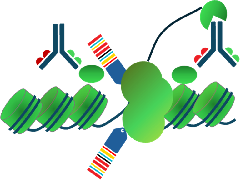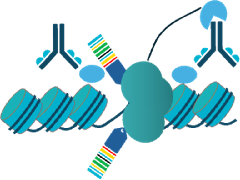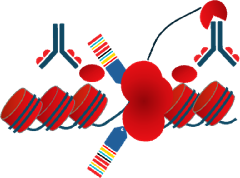
ChIP-seq
End-to-end ChIP-seq Services

- Full project: From chromatin preparation through analysis
- Library QC metrics and sequencing-ready material or FASTQ delivery
- Detailed report with QC, peak calls, and biological insights
Epigenome Technologies deploys validated poly-A, total, and long-read RNA-seq protocols so your project teams receive superior transcript quantification, isoform resolution, and regulatory context without pausing internal research. We qualify inputs, run the benchwork, and return interpretable deliverables that plug directly into downstream decisions.
Median Turnaround
10 business days
Quality Gates
Replicate R > 0.95
Assay Modes
Bulk + single-cell

RNA sequencing quantifies transcript abundance, isoform diversity, and regulatory RNA expression at genome-wide scale. We align poly-A selection, ribo-depletion, and long-read chemistries to specific biological questions and sample constraints, emphasizing when each approach delivers the highest signal-to-noise and interpretive clarity.


| Method | Best For | Key Applications |
|---|---|---|
| Poly-A RNA | mRNA quantification in eukaryotic systems; transcript-level abundance | Differential expression with high replicate concordance; gene-level quantification |
| Total RNA | Unbiased profiling of coding and non-coding RNAs | Bacterial transcriptomes; degraded or FFPE specimens; lncRNA and circRNA discovery |
| Long-read RNA | Full-length transcript isoforms; fusion events; alternative splicing | Structural rearrangements; allele-specific expression; novel isoform discovery |
Selectively captures mature, polyadenylated mRNA transcripts for efficient quantification of protein-coding gene expression. Integrates seamlessly with Multiome workflows combining ATAC and RNA-seq.
Captures both coding and non-coding RNA species—including lncRNAs, miRNAs, and other regulatory transcripts—for a complete transcriptional view.

Reconstructs complete transcript structures for isoform-level analysis, alternative splicing discovery, and fusion gene detection.

We confirm sample condition, RNA integrity, sequencing depth, and optional multiomic deliverables before kickoff.
RNA isolation and library construction with poly-A capture, ribo-depletion, or long-read protocols; QC on yield, fragment size, and library complexity.
Paired-end or long-read sequencing on Illumina or PacBio platforms with depth monitoring against internal standards.
Automated alignment, quantification, and differential expression analysis with pathway enrichment and data packages.


| Deliverable | Summary | SLA |
|---|---|---|
| Sequencing-ready libraries | Yield, sizing, and complexity documentation. | Day 10 |
| FASTQ and count matrices | Aligned reads, gene/transcript counts, metadata. | Day 14 |
| Interpretive report | Differential expression, pathway enrichment, and isoform summaries. | Day 16 |
Share your targets, cohort size, and required timelines. We will return a scoped RNA-seq brief outlining assay mix, QC checkpoints, and downstream reporting.